Tuesday, 30 October 2012

camera angles and shots

Camera angles
1) Bird’s-eye view:
A Bird’s-eye view shows a scene from overhead. Overhead of your character or even to show the setting but the shot doesn’t show anything as clearly as you may think it is. This camera shot makes the audience feel like ‘God’ as God watches over everything that happens over our heads. People would look as tiny as ants and that also makes the audience feel tall and proud.

2) High Angle:
This angle is similar to the Bird’s-eye view but not as high up. The camera is slanted in the action, hovering over the sides of the heads. This makes whatever you are trying to focus on smaller and insignificant. This action becomes part of a wider scale.

3) Eye Level:
The eye-level shot is placed in level with a character’s face as if the audience is watching in level with the focus.

4) Low Angle:
Low angles are mainly used to give an effect of how small you are to the world. Low angles shots give a sense of powerlessness and makes you feel useful in the scene and this type of camera angle would be useful for short actors like Danny Devito or Tom Cruise.

Camera movements
1) Pans:
This movement scans a scene horizonatally. Strange? Nope. The camera has to be placed on a tripod because soft shake’s of a movement is very sensitive and the audience would be able to access that mistake. The camera is turned to the side to often show a moving object in the middle of the frame.

2) Tilts: 
This can be similar to a ‘Pan’ shot although it scans the scene vertically.

3) Dolly Shots: 
This is sometimes called a ‘trucking’ or a ‘tracking’ shot. The camera is usually placed inside a vehicle or a plane, or mounted anywhere that creates movement if the director wants a complicated dolly shot. The dolly shots generally follow a moving object. The dolly shot is good for following the movement of a human or an object showing the journey from one end to another.

4) Hand-held Camera Shots: 
Hand held camera shots are moved by us, humans. This brings the audience to see as if they were inside them movie, witnessing an event that takes place. For instance, if a person is running in front of you and the hand-held camera shot is moving in a jerky unstable way focusing on the person running that may mean that that you are eyeing  chasing after them, watching every movement the person is doing in front of you. This type of camera angle is denotating reality when you are running behind another person rather than having a solid, boring camera angle.

5) Crane Shot: 
Crane Shots are similar to a dolly shot although it moves left, right, centre, up, down, diagonally etc. but in the air by using a large metal stand as you can see on the left here.

6) Zoom Lenses:
A zoom lense is use to change the magnification of an image by either using a close-up shot or a long shot in a camera (photographer) but the photographer standing a metre or two away. A zoom could be played out when the camera focuses on an object burried with other things but then zooms in quickly to face the main subject the director is trying to concentrate on. A zoom lense can be used with a trypod to stabalize.

7) Aerial Shot: Aerial shots are usually taken from a helicopter and is similar to a ‘Crane Shot’. You would usually find an ‘Aerial’ Shot in the beginning of a film to establish the setting and movement. This one is more exciting!
Camera shots

  • EWS (Extreme Wide Shot)
The view is so far from the subject that he isn't even visible. Often used as an establishing shot.

  • VWS (Very Wide Shot)
The subject is visible (barely), but the emphasis is still on placing him in his environment.

  • WS (Wide Shot)
The subject takes up the full frame, or at least as much as comfortably possible.
AKA: long shotfull shot.


  • MS (Mid Shot)
Shows some part of the subject in more detail while still giving an impression of the whole subject.

  • MCU (Medium Close Up)
Half way between a MS and a CU.

  • CU (Close Up)
A certain feature or part of the subject takes up the whole frame.

  • ECU (Extreme Close Up)
The ECU gets right in and shows extreme detail.

  • Cut-In
Shows some (other) part of the subject in detail.

  • CA (Cutaway)
A shot of something other than the subject.

  • Two-Shot
A shot of two people, framed similarly to a mid shot.

  • OSS (Over-the-Shoulder Shot)
Looking from behind a person at the subject.

  • Noddy Shot
Usually refers to a shot of the interviewer listening and reacting to the subject.

  • POV (Point-of-View Shot)
Shows a view from the subject's perspective.

  • Weather Shot
The subject is the weather. Can be used for other purposes, e.g. background for graphics.


North by North West


A hapless New York advertising executive is mistaken for a government agent by a group of foreign spies, and is pursued across the country while he looks for a way to survive. Roger Thornhill finds himself thrust into the world of spies when he is mistaken for a man by the name of George Kaplan. Foreign spy Philip Vandamm and his henchman Leonard try to eliminate him but when Thornhill tries to make sense of the case, he is framed for murder. Now on the run from the police, he manages to board the 20th Century Limited bound for Chicago where he meets a beautiful blond, Eve Kendall, who helps him to evade the authorities. His world is turned upside down yet again when he learns that Eve isn't the innocent bystander he thought she was. Not all is as it seems however, leading to a dramatic rescue and escape at the top of Mt. Rushmore.
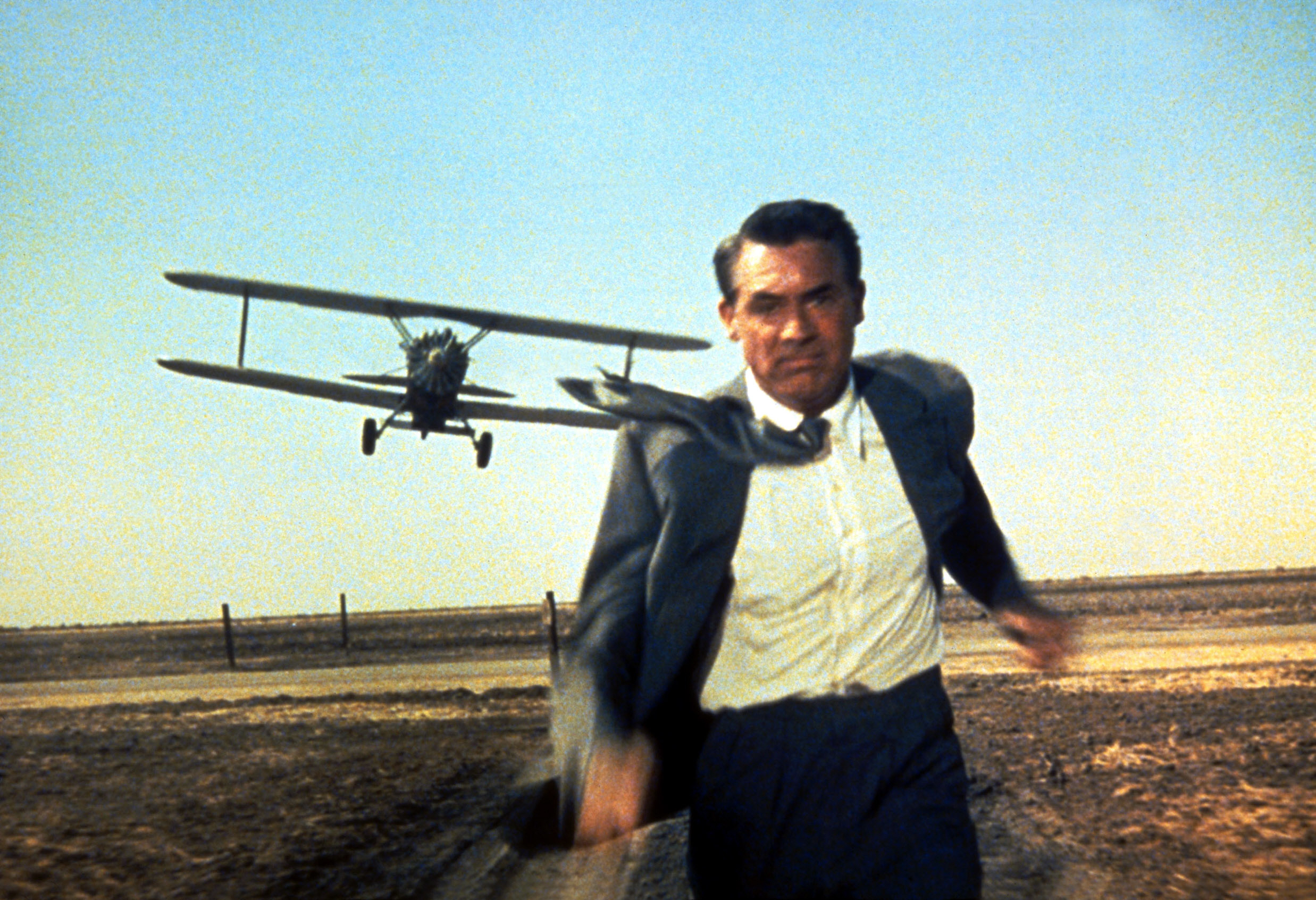
There is a famous scene that is a prime example of tension building and the use of different camera angles help to heighten the tension, the scene is so good that a certain shot of it was actually the poster for the film.
http://www.youtube.com/watch?v=g458w2X9uHc this link is the famous crop-dusting plane in action. 


Cary Grant was initially reluctant to accept the role of Roger Thornhill since at 55 he was much older than the character.The day before the scene where Thornhill is hidden in an upper berth was to be filmed,Cary Grant took a look at the set which had been built and told Alfred Hitchcock that it had been constructed sloppily and would not do for the film. Hitchcock trusted Grant's judgment so completely that he ordered the set rebuilt to better standards without ever checking the situation for himself. Cary Grant got $450,000 for this movie - a substantial amount for the time - plus a percentage of the gross profits. He also received $315,000 in penalty fees for having to stay nine weeks past the time his contract called for.

The final chase scene was not shot on Mt. Rushmore; Alfred Hitchcock couldn't gain permission to shoot an attempted murder on a national monument. The scene was shot in the studio on a replica of Mt. Rushmore. Everything is shot carefully, so as to avoid associating the faces of the monument with the violence. 

Director Cameo- Alfred Hitchcock:  Hitchcock arrives at a bus stop (during the opening credits) but gets there a second too late and the door is closed in his face. He misses the bus.


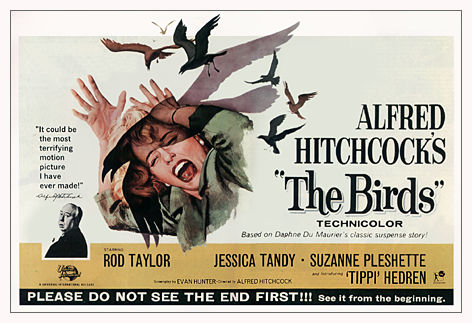
The Birds-1963


We recently watched a film called "The Birds" a film directed by the great Alfred Hitchcock, the film is a thriller that is about a change in the behaviour of the birds that inhabit bodega bay. The birds turn and start to attack to the residents. A wealthy San Francisco socialite pursues a potential boyfriend to a small Northern California town that slowly takes a turn for the bizarre when birds of all kinds suddenly begin to attack people there in increasing numbers and with increasing viciousness. Alfred Hitchcock saw Tippi Hedren in a 1962 commercial aired during the Today show and put her under contract. In the commercial for a diet drink, she is seen walking down a street and a man whistles at her slim, attractive figure, and she turns her head with an acknowledging smile. In the opening scene of the film, the same thing happens as she walks toward the bird shop. This was an inside joke by Hitchcock. When the children are running down the street from the schoolhouse, extra footage was shot back on the Universal sound stages to make the scene more terrifying. A few of the children were brought back and put in front of a process screen on a treadmill. They would run in front of the screen on the treadmill with the Bodega Bay footage behind them while a combination of real and fake crows were attacking them. There were three rows of children and when the treadmill was brought up to speed it ran very fast. On a couple of occasions during the shoot, a number of the children in the front fell and caused the children in back to fall as well. It was a very difficult scene to shoot and took a number of days to get it right. The birds used were hand puppets, mechanical and a couple were trained live birds. When audiences left the film's UK premiere at the Odeon, Leicester Square, London, they were greeted by the sound of screeching and flapping birds from loudspeakers hidden in the trees to scare them further. The scene where Tippi Hedren is ravaged by birds near the end of the movie took a week to shoot. The birds were attached to her clothes by long nylon threads so they could not get away.  The movie features 370 effects shots. The final shot is a composite of 32 separately filmed elements. The film does not finish with the usual "THE END" title because Alfred Hitchcock wanted to give the impression of unending terror.

Alfred Hitchcock


Alfred Hitchcock is a famous film director, notoriously known for his thriller. Hitchcock often had a small on scene appearance in his films minor parts that he would just make a passing appearance. Some of his most famous work include;

Made during his early career in Britain, The 39 Steps is stamped with Hitchcock movie hallmarks - an innocent man on the run, unwillingly accompanied by an icy blonde who's not sure she can trust him. It's a spy mystery that jaunts across the streets of London to the Scottish countryside, with a tight plot and clever dialogue. There's good chemistry between Robert Donat as the plucky Canadian hero and Madeleine Carroll literally handcuffed together. Donat is delightful when he is mistaken for a political candidate and has to give a rousing, impromptu speech - a scene Hitchcock would repeat in subsequent films. 


Hitchcock also directed North by North West, Psycho and TheBirds all great films that are full of suspense and drama throughout. 
He framed shots to maximise anxiety, fear, or empathy, and used innovative film editing. His stories frequently feature fugitives on the run from the law alongside "icy blonde" female characters. Many of Hitchcock's films have twist endings and thrilling plots featuring depictions of violence, murder, and crime, although many of the mysteries function as decoys or "MacGuffins" meant only to serve thematic elements in the film and the psychological examinations of the characters.
Hitchcock directed more than fifty feature films in a career spanning six decades. Often regarded as the greatest British filmmaker, he came first in a 2007 poll of film critics in Britain's Daily Telegraph, which said: "Unquestionably the greatest filmmaker to emerge from these islands, Hitchcock did more than any director to shape modern cinema, which would be utterly different without him. His flair was for narrative, cruelly withholding crucial information (from his characters and from us) and engaging the emotions of the audience like no one else."

Some of his famous films include the following;

Vertigo
Vertigo (1958)
Rear Window
Rear Window (1954)
North by Northwest
North by Northwest (1959)


Wednesday, 17 October 2012

what is a thriller?

A thriller can range from different genres they are commonly full of suspense which is the main feature of a thriller film. A thriller can often include over lapping genres to add to the tension and appeal to different audiences. Thrillers often have lots of fast paced action, the actions is usually frequent however in some thrillers suspense is used to build up tension before a piece of action. A typical thriller will have a very powerful and equipped villain that has plans that will effect lots of people, the hero or heroin will not be as prepared and must overcome lots of objects to defeat the villains plans. 
Many devices such as suspense, red-herrings and cliff hangers are used to add to the tension of a thriller. 
A thriller will often be non linear to make the audience wonder and think more about what is going on. Swordfish is a non linear film that makes you think of how they got to the point they are at. the film shows flashback of what is going on. 
The image below is one of the opening scenes from Swordfish, a bomb that was attached to a hostage has gone off and there in carnage on the streets surrounding where the other hostages are being kept.